
Management System
We introduce you to Podravka’s management system through the basic principles and policies of standards, business practices, and regulations of the Republic of Croatia, the European Union, and the countries in which we operate.


We recognize market requirements, regulations, and consumer expectations in order to ensure the highest level of product safety and quality through our business processes.
- we operate according to the strictest food safety and quality standards, as well as the laws of all the countries in which we operate
- by applying the leading food safety standards IFS Food and BRCGS Food Safety, we confirm the safety of our products through the application of good manufacturing practice and quality management principles
- we carry out quality control and health safety checks in laboratories integrated through the SAP QM information system
- with the knowledge and expertise of our employees, we maintain the established food safety and quality system
- we strengthen the culture of food safety and quality at all levels of the company
- we continuously improve our systems and processes through systematic monitoring, identification, and implementation of improvement opportunities in order to meet market expectations and ensure safety, quality, and sustainability of operations
Principles of the quality management system
The seven principles of the quality management system (according to ISO 9001) are the foundation for effective management and improvement of company quality.
Our commitment to each of these areas enables us to remain a reliable partner on the market, providing products and services of the highest quality and building trust with customers and the community.

Customer focus – organizations depend on their customers and should understand their needs and expectations, and strive to exceed them.
Leadership – leaders at all levels establish a unified direction, purpose, and create conditions for involving people in achieving quality objectives.
Engagement of people – involving employees at all levels is key to the organization’s effectiveness – their full involvement enables the use of their abilities.
Process approach – results are achieved more effectively when activities and resources are managed as a process.
Improvement – continual improvement should be a permanent objective of the organization.
Evidence-based decision making – decisions based on the analysis of accurate and reliable data increase the likelihood of achieving desired results.
Relationship management – the organization should manage relationships with relevant stakeholders (suppliers, partners, etc.) in order to ensure long-term success.
Continuous improvement of the management system
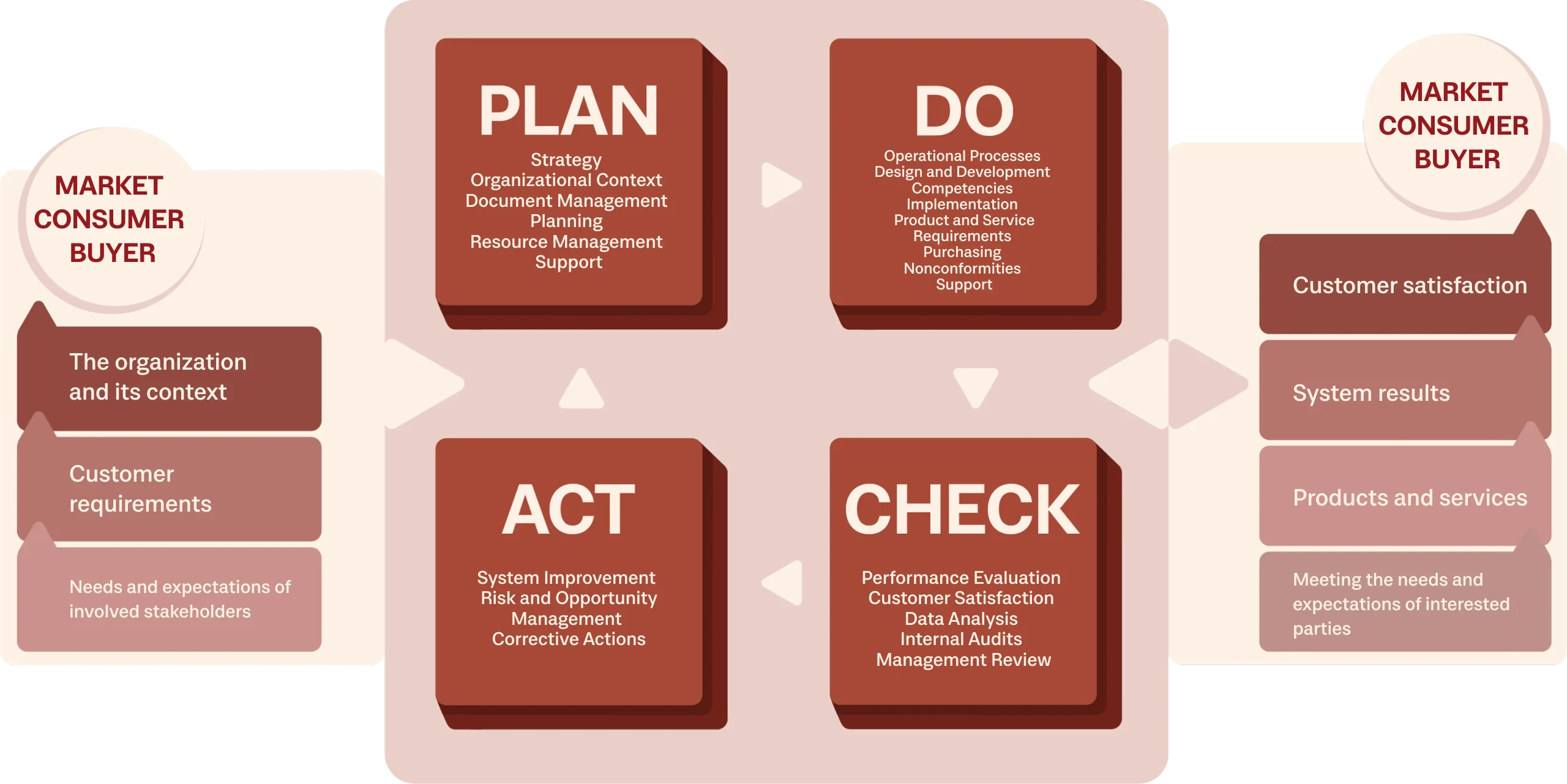
The company continuously improves its management system through the application of the PDCA cycle (Plan-Do-Check-Act).
Through the planning of objectives and processes, implementation of activities, monitoring of effectiveness, management of corrective actions and areas for improvement, we ensure continuous progress in quality, food safety, and compliance with relevant market and legislative requirements.
Continuous improvement of the management system
Quick links
Instantly access related content.